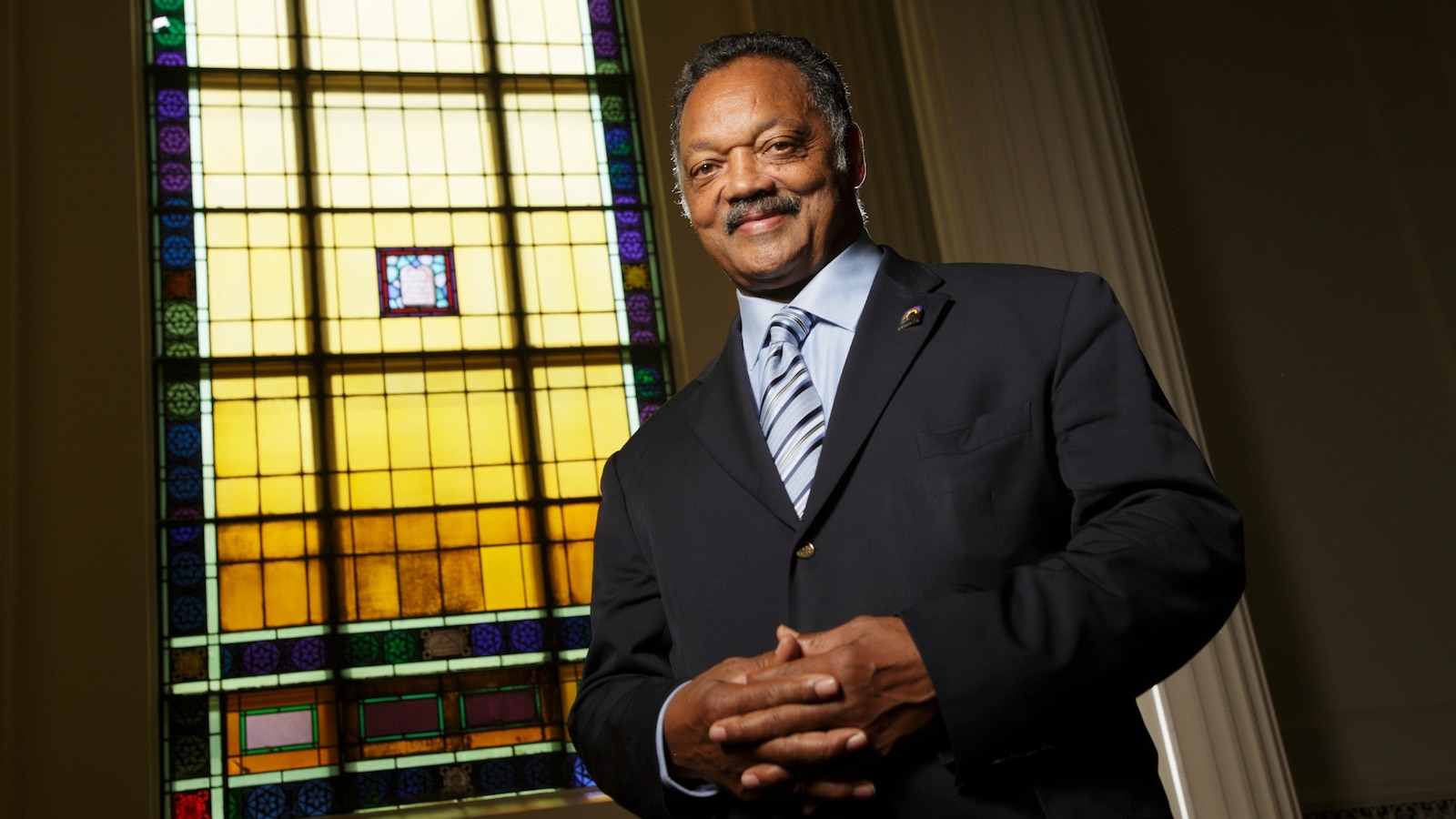
The Rev. Jesse Jackson, the civil rights leader, Baptist minister and pioneering politician who launched two bids for the U.S. presidency, died Tuesday morning at the age of 84, his family said in a statement.
“Our father was a servant leader – not only to our family, but to the oppressed, the voiceless and the neglected around the world,” the family statement said.
She added: “We shared him with the world, and in return, the world became part of our extended family. His unwavering belief in justice, equality and love uplifted millions, and we ask that you honor his memory by continuing to fight for the values by which he lived.”
Jackson left behind his wife, Jacqueline Jackson, whom he married in 1962, and six children.
Rev. Jesse Jackson at Rainbow Push headquarters in Chicago, August 4, 2011.
John Grace/Corbis via Getty Images
Jackson has faced a myriad of health issues in recent years. In November 2025, Jackson He was taken to hospital He is in Chicago to treat complications of progressive supranuclear palsy (PSP), a neurodegenerative condition he has been treating for a decade, according to a statement from the Rainbow PUSH coalition, the civil rights organization Jackson founded.
“Pastor Jackson is in stable condition and breathing without the assistance of machines,” Jackson’s family said in a statement a few days after Jackson was admitted to the hospital in response to speculation about his condition. “Contrary to specific reports, he is not on life support.”
The statement also said, “The Jackson family extends their deep appreciation for the many prayers and kind messages offered during this time.” It was Jackson He was discharged from the hospital The following week.
The family issued another update on Jackson’s health in mid-December 2025, when they issued a statement saying Jackson had been released from an acute care facility where he “received additional care” after being discharged from the hospital. The statement also said Jackson “suffered multiple injuries consistent with his evolving diagnosis of PSP” over the “past several months.”

Rev. Jesse Jackson stops at a demonstration outside the US Capitol to protest the end of the federal moratorium on residential evictions in Washington, US, on August 2, 2021.
Evelyn Hochstein – Reuters
In 2017, Jackson announced that he was Diagnosis of Parkinson’s disease. However, the November 2025 announcement stated that the PSP diagnosis was confirmed last April.
Beginning his career as a student of Dr. Martin Luther King, Jr., Jackson quickly rose to become one of the country’s most prominent and influential civil rights leaders. In 1971, he founded the non-profit Operation PUSH – People United to Save/Serve Humanity – to advocate for social and economic equality for black Americans.
Jackson ran for president twice, both times as a Democrat, and finished third for the party’s nomination in 1984 and second in 1988, marking the most successful presidential runs of any black candidate before the two decades of Barack Obama’s presidency.
After his first campaign, Jackson formed the non-profit National Rainbow Coalition with the stated goal of giving minority Americans a greater political voice. In 1996, Jackson merged the two groups into Rainbow/PUSH, and served as president of both until 2023.
Jackson was also elected in 1990 as a shadow delegate for the District of Columbia, serving one term. In 2000, President Bill Clinton awarded Jackson the Presidential Medal of Freedom, the nation’s highest civilian honor.

Rev. Jesse Jackson, Director of PUSH (People United to Save Humanity) in Chiago.
Pittman Archive via Getty Images
Jesse Louis Jackson was born on October 8, 1941 in Greenville, South Carolina, in the segregated South, and grew up poor in a farming family. He was a talented student and athlete, graduating from high school with offers for a Little League baseball contract and a Big Ten football scholarship.
He instead chose to attend the University of Illinois before transferring to and graduating from the University of North Carolina A&T, a historically black university. He then began theological studies before going to work full-time with Dr. King and the Southern Christian Leadership Conference (SCLC). He was ordained a Baptist minister in 1968.
In 1966, the 24-year-old Jackson became president of the Chicago chapter of the fledgling Operation Breadbasket, the economic activism arm of the Southern Christian Leadership Conference, and was named its national director the following year. He also helped found the Chicago Freedom Movement to work for open housing and school desegregation.
Jackson participated in many of the civil rights movement’s historic moments, including the March on Washington in 1963, where King delivered his famous “I Have a Dream” speech, and the Selma to Montgomery marches in Alabama in 1965. He was also with Dr. King when the civil rights leader was gunned down at the Lorraine Hotel in Memphis, Tennessee, on April 4, 1968.

Civil rights leader, Jesse Jackson with Dr. Martin Luther King, in 1966.
World History Archive via Getty Images
Reflecting on Dr. King’s memory nearly 50 years later, Jackson said he was inspired by his ability to remain courageous even in the face of enormous challenges.
“It’s a frame of reference. His resurrection is powerful,” Jackson said. In a 2018 interview With ABC Chicago station WLS.
Speaking about King’s assassination, Jackson added: “All I can remember is a voice saying: ‘One bullet cannot kill a movement.’ We have to keep going… If your starter is hurt on the field, you can’t lose the game. You have to embrace your pain and keep moving, and we have to be loyal to his leaders 50 years later.”
Three years after King’s murder, Jackson left the Southern Christian Leadership Conference and founded Operation PUSH, a social justice organization dedicated to improving the economic conditions of black communities across the United States.
The organization fought to provide greater educational and employment opportunities for black Americans, and succeeded in forcing major corporations to adopt affirmative action policies that benefited black workers.
Jackson’s social activism developed into a political ambition in the 1980s, when he launched two campaigns for the Democratic presidential nomination, in 1984 and 1988. He finished third in the primary vote in 1984 and was second to Democratic nominee Michael Dukakis in 1988, winning 12 primaries and caucuses and receiving about 6.9 million votes.

American religious civil rights leader and politician Rev. Jesse Jackson speaks at the headquarters of Operation PUSH (People United to Save Humanity), Chicago, July 17, 1981.
Antonio Deci/Getty Images
As only the second Black American to mount a nationwide presidential campaign, after New York Rep. Shirley Chisholm in 1972, Jackson’s historic outings were the most successful by a Black candidate until President Barack Obama won in 2008.
Jackson eventually won political office, when he was elected to serve in the United States Senate as a shadow delegate for the District of Columbia, from 1991 to 1997.
Jackson also used his skills as a negotiator to facilitate the freedom of people detained abroad, leading to the 1984 release of Navy pilot Robert Goodman from captivity in Lebanon after his plane was shot down, as well as three American prisoners of war held by Yugoslav President Slobodan Milosevic in 1999.
In 2000, President Bill Clinton awarded Jackson, a frequent critic of Clinton and his policies, the Presidential Medal of Freedom, the nation’s highest civilian honor, in recognition of Jackson’s decades of social activism.
“It is difficult to imagine how we could have gotten where we are without the creative power, insightful thought, loving heart, and relentless passion of Jesse Lewis Jackson,” Clinton said. He said at the ceremony. “By God, he’s not done with him yet.”

Rev. Jesse Jackson waves as he appears on stage during the 2024 Democratic National Convention in Chicago, August 19, 2024.
Bill Clark/CQ-Roll Call via Getty Images
Jackson received numerous other awards throughout his life, including the NAACP President’s Award and the American Institute of Public Service’s Jefferson Award. In 2021, Jackson was awarded France’s highest order of merit, the Legion of Honour.
In later years, Jackson was an outspoken supporter of the reauthorization of the Voting Rights Act of 1965. He was also involved in Operation Black Vote in the United Kingdom to promote minority participation in British elections.
In July 2023, Jackson stepped down as president of the Rainbow PUSH Coalition after more than 50 years as its president. “We are resigning, we are not retiring,” Jackson said at the time, pledging to continue fighting for social justice issues.
ABC News” Ahmed Hemingway She contributed to this report.