After their historic flyby of the Moon, the Artemis 2 crew is nearing the end of their 10-day mission, which will conclude on Friday with the most intense phase of any astronaut’s journey: reentry into Earth’s atmosphere, followed by landing.
This is the crucial moment when the spacecraft proves it can safely transport its crew home. But when the re-entry process begins, the world will need to wait about six minutes for this evidence, which is the amount of time that Mission Control will lose contact with the Artemis II crew.
Watch live coverage of the Artemis II crew’s return to Earth starting at 7 PM ET on ABC News Live, Disney+ and Hulu with special coverage starting at 7:30 PM ET on ABC.
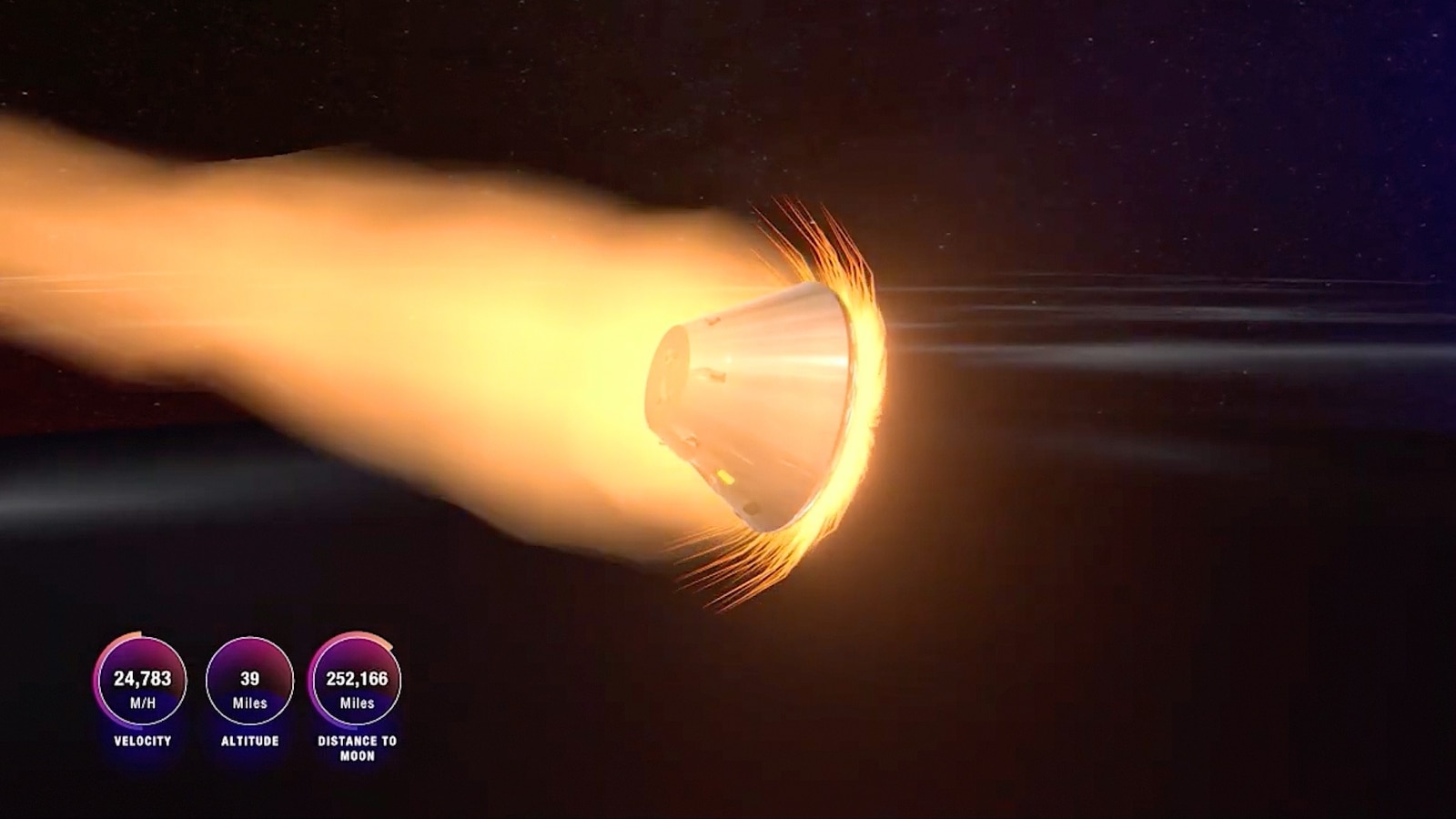
Visualization of the Artemis I spacecraft entering Earth’s atmosphere as Artemis II prepares to land in the Pacific Ocean on April 10, 2026.
NASA
Unlike the 40-minute loss of communications when Orion’s crew module passed behind the Moon, effectively blocking radio signals from reaching the spacecraft, the loss of communication during reentry results from Orion’s passage through Earth’s atmosphere.
What happens when you start coming back?
Orion will fall to Earth at midnight 24,000 mph When it encounters the atmosphere. As the atmosphere thickens, friction will slow down the spacecraft. It will also generate a lot of heat – up to 5,000 degrees Fahrenheit, It is more than twice as hot as lava – turning Orion into a fireball.
It would take about 13 minutes to travel 400,000 feet from space to land off the coast of San Diego, California.
“Everything is different,” retired NASA astronaut Barry “Butch” Wilmore told ABC News. “The speeds are much faster coming back from deep space.”
Together, the friction and pressure in the atmosphere as Orion falls creates a plasma bubble that will engulf the spacecraft, according to NASA. It’s that sweeping plasma that doesn’t let radio signals in or out.

Orion captured this high-resolution selfie in space with a camera mounted on one of its solar wings during a routine external inspection of the spacecraft on the second day of the Artemis 2 mission, April 3, 2026.
NASA
Within seconds, the Artemis II crew will lose contact with ground controllers as NASA calls a “six-minute planned blackout period.”
What happens inside Orion?
“You know a blackout is coming,” said Wilmore, who re-entered from space three times during his time as an astronaut. “That’s why you just click like your normal operations, you’re watching. There’s not much you can do.”
Everyone inside the spacecraft is focused on monitoring the onboard systems as they descend through the atmosphere, according to Willmore, who added that astronauts train for “all kinds of failures,” so their mindset is to focus solely on the jobs at hand.
“You can’t let concerns affect you in those time frames,” Wilmore told ABC News. “You have to focus on your mission, whatever it is, and you have to do it, because if you don’t, the consequences will be very dire.”
when the The signal goes out, and the heat shield intervenes
Those six minutes of radio silence also occur when Orion’s heat shield, located on the underside of the spacecraft, does its most important work, protecting Orion and its crew from extreme temperatures upon return. Onboard maneuvering jets ensure Orion maintains the required orientation to keep the heat shield pointed toward Earth during reentry.

Commander Reed Wiseman gazes at Earth from Orion’s windows, a reminder of home as they travel toward the Moon.
NASA
After Orion completes its passage through the exosphere and emerges from the communications blackout, it will remain that way Traveling too fast to survive a fall into the Pacific Ocean. That’s when a series of specially designed Parachutes will deploy, slowing Orion’s speed to a safer distance of 20 mph at the time of the plane’s descent.
Orion’s landing is scheduled to take place at 5:07 PM PT/8:07 PM ET on Friday, April 10. site Off the coast of San Diego.