
The federal judge presiding over the challenge to the White House ballroom project indicated deep doubts about the Trump administration’s argument that the president has the legal authority to undertake East Wing renovations and fund them with private donations.
At a hearing Thursday, U.S. District Judge Richard Leon pressed the administration’s lawyers on those two issues, questioning whether the president had the power to tear down part of what he called “the symbol of the national institution,” and calling the intention to fund it with private gifts a “Goldberg-type contraption” that would evade congressional oversight.
National Trust for Historic Preservation A lawsuit was filed last month seeking to halt construction of the ballroom until the project completes the standard federal review process for federal construction projects and the administration seeks public comment on the proposed changes.
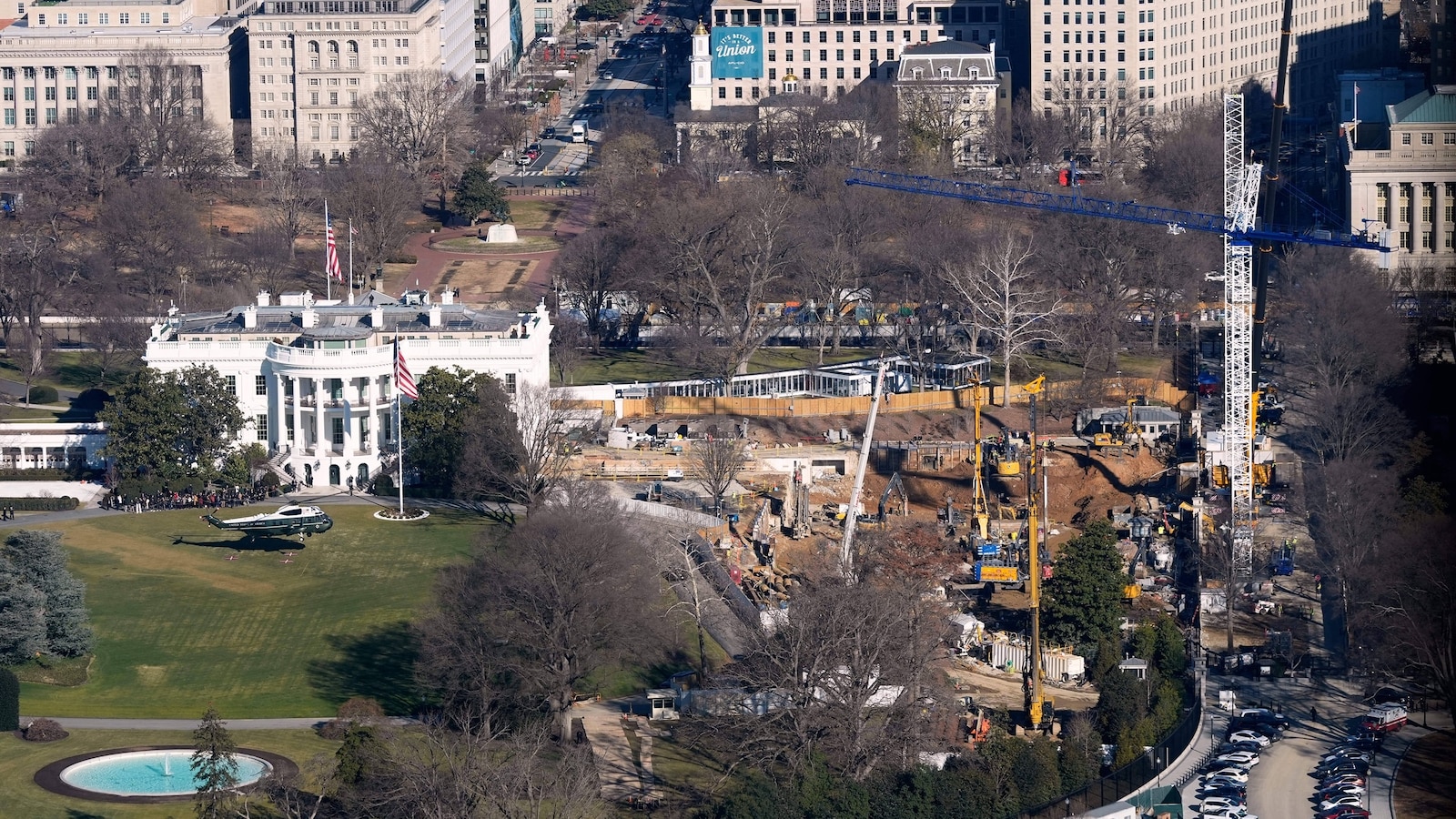
Marine One, with President Donald Trump on board, takes off from the South Lawn on January 13, 2026 at the White House.
Pablo Martinez Monsivais/AP, File
The National Trust, a privately funded nonprofit appointed by Congress to protect historic sites, was seeking a preliminary injunction.
At the end of the hour-long hearing on Thursday, Judge Leon said he would likely not issue a decision this month, but “hopefully” it would come in February. He said he expected the losing side to appeal the ruling.
In a statement provided to ABC News, White House spokesman Davis Engel said: “President Trump is working 24/7 to make America great again, including his historic facelift of the White House, at no expense to taxpayers. These long-overdue improvements will benefit generations of future presidents and American visitors to the House.”
The white house He announced the construction of a 90,000-square-foot banquet hall In late July, demolition suddenly began on the east wing In late October, when workers were seen demolishing the wing of the White House that housed the first lady’s offices.
The project has increased in size and cost since it was first unveiled. In November, Trump said the project would cost $400 million, after an initial estimate of $200 million. The White House said the project will be funded through private donations.
Judge Lyon, an appointee of George W. Bush, said the Trump administration appeared to be making a “final go-around” on congressional oversight with the president’s plan to raise $400 million privately for the auditorium project, and advised Justice Department lawyers to be “serious” in justifying the legal rationale for it.

An excavator works to remove rubble after the demolition of the East Wing of the White House, October 23, 2025.
Eric Lee/Getty Images
While the case represents a series of complex and overlapping legal issues, the judge spent most of the hearings focusing on just two federal laws — one that states that “no building or structure” may be erected on any federal public land in the District of Columbia “without the express authority of Congress,” and the other that calls for annual appropriations for “maintenance, repair, alteration and refurnishing.” [and] Improving the White House.
Leon pointed out that Republicans control both chambers of Congress, and that the president could have gone to lawmakers to obtain approval for the demolition and rebuilding. He also noted that the $2.5 million Congress recently appropriated for White House upkeep was for “very small projects,” not a ballroom.
Justice Department lawyer Yaakov Roth countered that Trump did not want to use $400 million in taxpayer money on the project, when he could ask for gifts from the National Park Service to fund it instead. Roth also noted that Congress under Gerald Ford was never asked to approve the construction of a swimming pool or tennis pavilion during Trump’s first term.

President Donald Trump holds up a blueprint of the planned White House auditorium expansion during a meeting with Mark Rutte, Secretary General of the North Atlantic Treaty Organization (NATO), not pictured, in the Oval Office of the White House, October 22, 2025.
Aaron Schwartz/CNP/Bloomberg via Getty Images
“[Your argument for using NPS’s gift authority] On the icon of this national treasure, what? Gerald Ford 77 pool?” Leon asked. “Would you compare that to tearing up the East Wing? Let’s go! Be serious.”
Leon said he saw “no basis” in the legislative history of the Park Service’s gift authority that would allow Trump to use it to raise $400 million to build a new White House ballroom. “Nothing,” Leon said. “zero.”
In his defense of the National Trust, attorney Tad Hoyer described the president as “a temporary tenant of the White House, not the owner.” Leon suggested that “host” might be a more appropriate term.
“He’s not the owner,” Hoyer said.
President Donald Trump holds up a blueprint of the planned White House auditorium expansion during a meeting with Mark Rutte, Secretary General of the North Atlantic Treaty Organization (NATO), not pictured, in the Oval Office of the White House, October 22, 2025.
Aaron Schwartz/CNP/Bloomberg via Getty Images
When Roth took the stand to begin his argument on behalf of the administration, he tried to convince the judge that the National Trust had no right to sue. Leon suddenly interrupted him.
“I’m very comfortable standing in this state,” Lyon said. “Sorry to disappoint you. You’ll get your chance at the Court of Appeals.”
Roth warned the judge that ordering a halt to construction at this point could expose the existing White House structure to damage and potentially lead to security concerns, since replacing a previously existing underground bunker is widely believed to be part of the project. The National Trust said it would not object to construction continuing on the security part of the work.
“It can’t be divided that way, unless we want the court to do so,” Roth said of the security-related construction. To be the project manager on site.”
Leon declined to issue a bench warrant. He said the upcoming winter storm makes it unlikely he will issue a ruling on the National Trust’s proposal for a preliminary injunction before the end of this month.
ABC News’ Michelle Stoddard contributed to this report.
Editor’s note: An earlier version of this story misidentified an attorney for the National Trust for Historic Preservation. The story has been corrected and updated.